Crystals#
Every pyEMAPS simulation and calculation starts from a Crystal
object loaded with crystal data. This example loads Silicon from the built-in crystal library
with from_builtin():
from pyemaps import Crystal

si = Crystal.from_builtin('Silicon')
The crystal is then ready for simulations and calculations.
Crystals can also be loaded from your own data:
from_xtl(): an EMAPS.xtlfilefrom_cif(): a CIF filefrom_json(): a JSON filefrom_dict(): a Python dictionary
A file name without a folder is looked for in the current working directory, then in the data folder. See Data folder and license.
Built-in crystals#
list_all_builtin_crystals() returns the names of the built-in
crystals:
from pyemaps import Crystal

print(Crystal.list_all_builtin_crystals())
The library has 44 crystals:
'Aluminium', 'AluminiumOxide', 'Aluminium_FCC', 'BariumTitanate_180k', 'BariumTitanate_270k',
'BariumTitanate_Tetra', 'BiMnO3', 'Boron_Tetra', 'CadmiumSelenide_Hex', 'CadmiumSulfide_Cubic',
'CadmiumSulfide_Hex', 'Chromium_BCC', 'CopperOxide', 'Copper_FCC', 'CoSb3_Skutterudite',
'Cu2O_Cuprite', 'Diamond', 'ErbiumPyrogermanate', 'FePd_Tetra', 'FeS2_Pyrite',
'GalliumAntimonide', 'GalliumArsenide', 'GalliumNitride', 'Germanium', 'Gold_FCC',
'IndiumArsenide', 'LaMnO3', 'LeadZirconateTitanate', 'Li2MnO3', 'limno2', 'NaFeO2', 'Nb3Sn',
'Pentacene', 'Silicon', 'StrontiumTitanate', 'TelluriumDioxide', 'TinDioxide_RT',
'TitaniumDioxide_Anatase', 'TitaniumDioxide_Rutile', 'TungstenDiselenide', 'VanadiumDioxide_RT',
'ZincOxide', 'Zinc_HCP', 'ZirconiumNitride'
Constructing crystal structures#
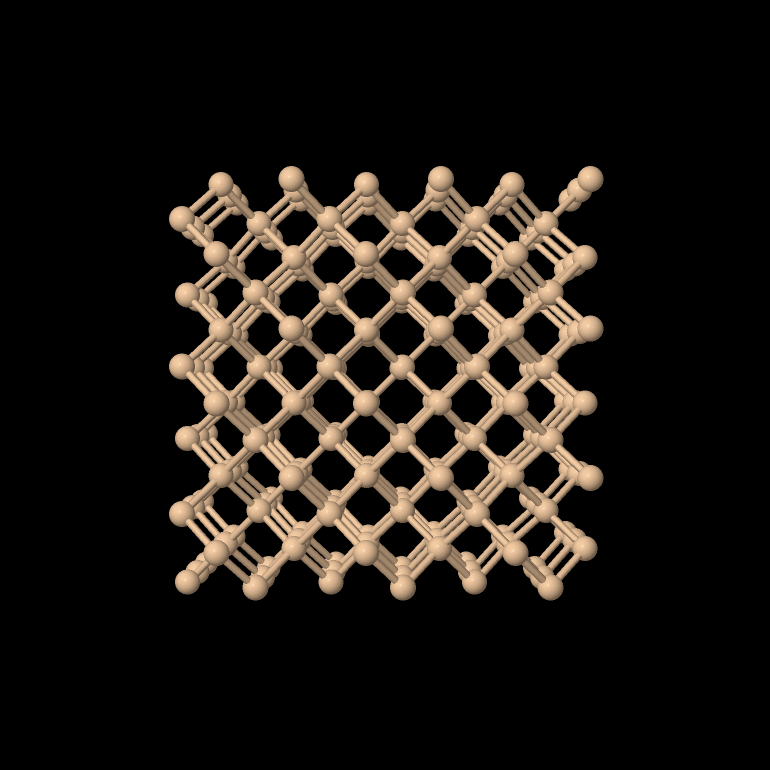
generateMxtal() builds a block of the crystal’s atomic
structure (a supercell) from its unit cell, and
writeXYZ() saves it as an .xyz file:
from pyemaps import Crystal

si = Crystal.from_builtin('Silicon')
mx = si.generateMxtal()
si.writeXYZ(mx)
The file is saved in the mxtal subfolder of the data folder. Tools such as Jmol can import it to show the structure in 3D: